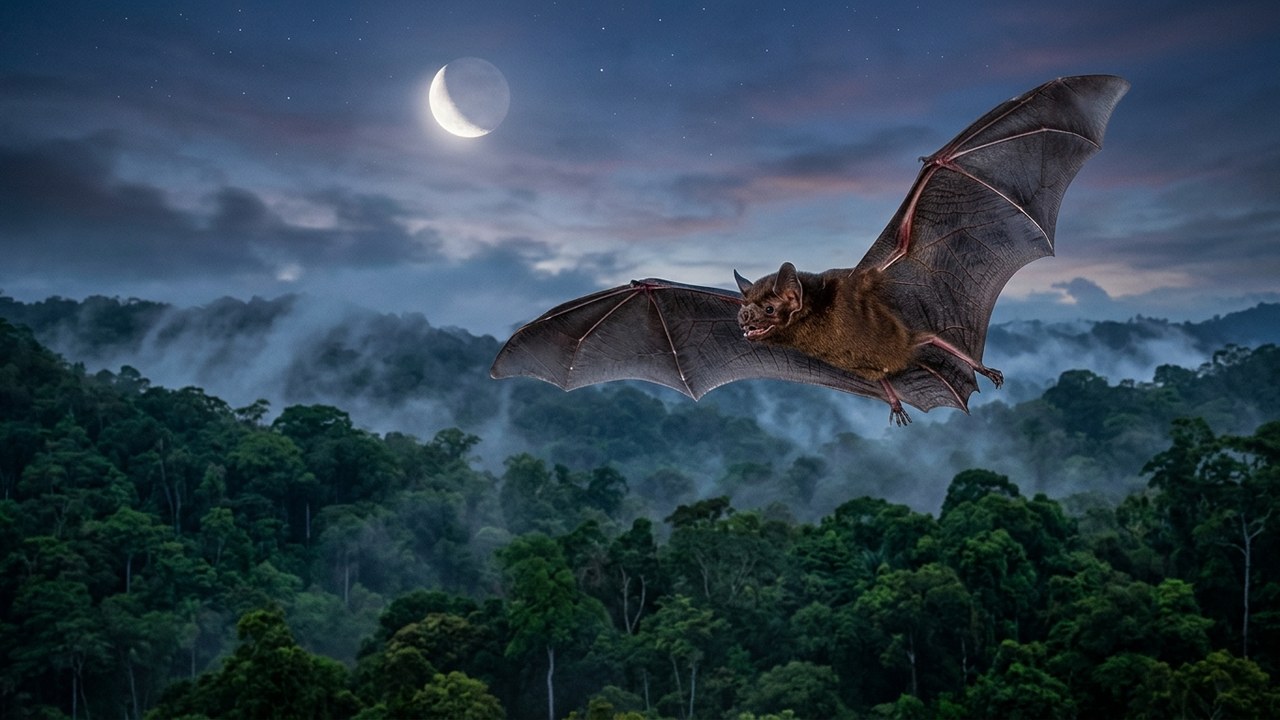
Representing roughly one-fifth of all known mammal species on Earth, bats (Order Chiroptera)—more than 1,400 distinct species worldwide—are the only mammals engineered for true, powered sustained flight. Emerging at twilight over tropical rainforests, deserts, and farmlands, bats execute aerial maneuvers that continue to inspire aerospace engineers and acoustic physicists alike.
Ultrasonic Sonar: Seeing the Night Through Sound
Most insectivorous bats navigate complete darkness through biological echolocation. By contracting specialized laryngeal muscles at astonishing speeds, bats emit high-frequency ultrasonic pulses ranging from 20 kHz to well above 120 kHz—far beyond human hearing. When these sound waves strike foliage, canyon walls, or flying insects, faint echoes rebound to the bat’s sculpted outer ears.
- Microsecond Spatial Mapping: The bat’s auditory cortex calculates distance from echo delay and direction from minute intensity differences between left and right ears.
- Doppler Shift Precision: Certain horseshoe and leaf-nosed bats detect tiny pitch shifts caused by fluttering moth wings, isolating prey cleanly against dense rainforest canopies.
- The Feeding Buzz: As a bat closes in on a target, call rates accelerate from 10 pulses per second to nearly 200 pulses per second, creating a real-time 3D acoustic image.
Aerodynamic Mastery of Living Wing Membranes
Unlike birds whose rigid feathers generate lift, a bat’s wing is a flexible, living membrane called the patagium stretched across elongated finger bones. Tiny microscopic hairs connected to specialized Merkel touch cells cover the wing surface, sensing subtle air turbulence in milliseconds so the bat can curve its wings mid-stroke and execute tight mid-air pivots impossible for fixed-wing aircraft.
Global Ecological Impact
A single colony of insect-eating bats can consume millions of agricultural pests each night, saving global farmers billions of dollars annually in crop protection. Meanwhile, nectar- and fruit-eating bats pollinate over 500 tropical plant species—including wild bananas, mangoes, guavas, and agave.
Debunking the “Blind as a Bat” Myth
Contrary to popular folklore, no bat species is blind. Large fruit bats (flying foxes) actually rely primarily on sharp low-light vision and acute olfactory senses rather than laryngeal echolocation, spotting ripe canopy fruit and twilight landmarks across long migration corridors. Even echolocating microbats use vision at dusk to orient toward distant mountain horizons.
Conservation Priorities for Nocturnal Ecosystems
Healthy bat populations are critical indicators of intact ecosystems. Because bats reproduce slowly—often raising just a single pup per year—preserving undisturbed cave roosts, protecting old-growth forest canopies, and reducing excessive artificial night lighting are essential priorities for global wildlife stewardship.
Frequently Asked Questions
Why don’t bats deafen themselves with their own loud sonar calls?
Milliseconds before emitting each ultrasonic pulse, tiny middle-ear muscles contract automatically to dampen outgoing sound, then instantly relax to receive delicate returning echoes.
How do thousands of bats fly out of a cave without colliding?
Bats dynamically adjust their call frequencies and timing offsets—a behavior called jamming avoidance—while also tracking neighboring wingbeats visually and acoustically.
How long can wild bats live?
For their small body size, bats possess extraordinary longevity and immune resilience, with documented wild specimens living 20 to 35 years.