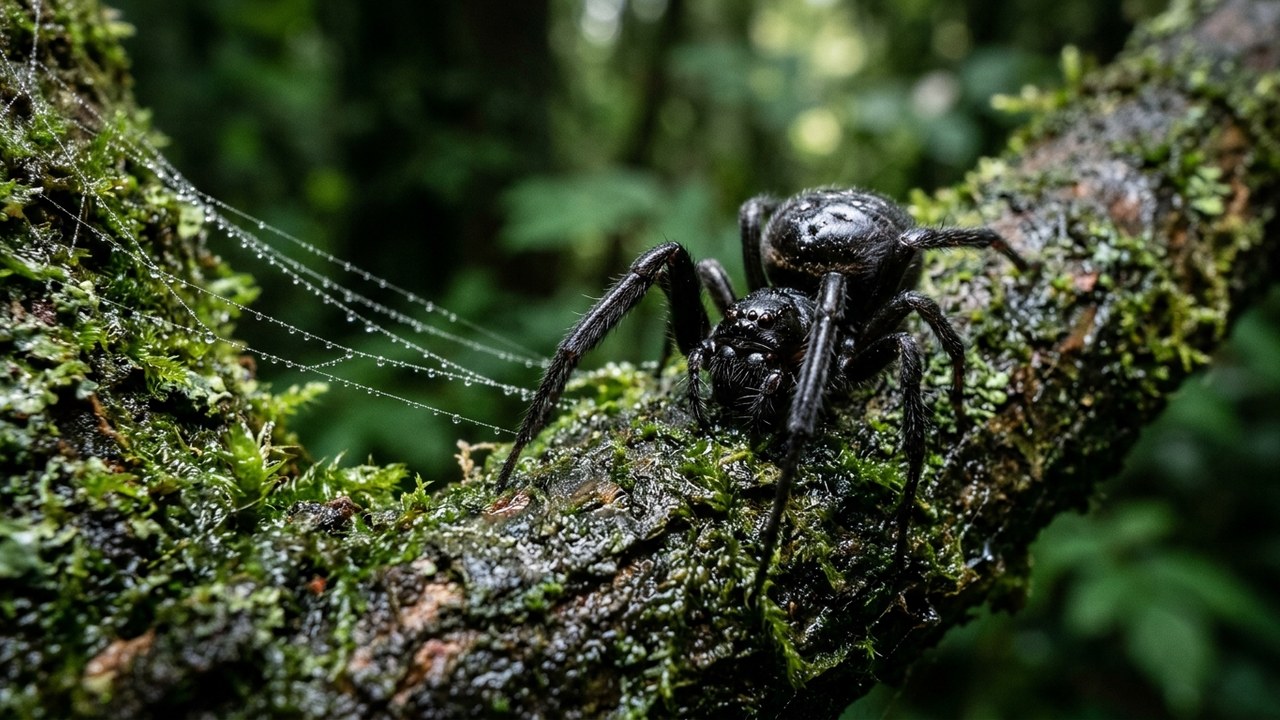
Across tropical rainforests, temperate woodlands, and arid canyons, rare black spiders occupy an astonishing range of ecological niches. From the docile Brazilian Black Tarantula (Grammostola pulchra) and glossy trapdoor spiders to sleek nocturnal hunters, dark coloration provides superior camouflage in shadowed leaf litter while aiding thermoregulation after cool nights.
The Engineering Marvel of Spider Silk
Few biological materials rival the mechanical elegance of spider silk. Produced from specialized abdominal spinnerets fed by up to seven distinct silk glands, liquid crystalline proteins called spidroins solidify instantly into solid fibers upon extrusion. Dragline silk—used for safety lifelines and structural web frames—exhibits a tensile strength-to-weight ratio surpassing high-grade alloy steel while stretching up to 40% before breaking.
- Vibration Telemetry: Fine taut silk lines act as acoustic antennas, allowing a hidden spider to determine the exact mass, distance, and struggle frequency of approaching insects.
- Biocompatible Design: Materials scientists actively study synthetic spidroins for surgical sutures, lightweight protective composites, and biodegradable medical dressings.
- Zero-Waste Recycling: Many web-building species consume older damaged silk strands overnight to reclaim valuable amino acids before spinning fresh architecture at dawn.
Venom Biochemistry: Precision Over Brute Force
Spider venom is a highly refined biochemical library composed of hundreds of disulfide-rich peptides, polyamines, and enzymes. Unlike broad-spectrum toxins, these molecules evolved to lock onto specific voltage-gated ion channels in insect nervous systems, immobilizing prey rapidly so the spider avoids injury during hunting.
Biomedical Significance
Over 50,000 spider species have been cataloged globally, yet researchers estimate less than 1% of spider venom peptides have been fully screened—making arachnid biochemistry one of the richest unexplored frontiers in modern life sciences.
Ecological Guardians of Global Biomes
Global ecological surveys estimate that spiders collectively consume between 400 million and 800 million metric tons of insects annually—exceeding the total meat consumption of humanity. By regulating mosquito, beetle, and crop-pest populations naturally, rare black spiders protect woodland biodiversity and reduce agricultural damage without chemical intervention.
Responsible Study and Habitat Stewardship
Ethical arachnid study emphasizes non-invasive observation, verified captive breeding, and clean biosecurity. Key environmental pillars for forest-dwelling dark spiders include cross-ventilated enclosures to prevent stagnant mold growth, undisturbed vertical or burrowing hides, stable room temperatures (22°C–26°C), and clean hydration without oversaturating substrates.
Frequently Asked Questions
Are all glossy black spiders dangerous?
No. The vast majority of black spiders—including trapdoor spiders, black jumping spiders, and Brazilian Black Tarantulas—pose minimal medical risk to humans and retreat rapidly when disturbed.
How do spiders walk on their own webs without getting stuck?
Spiders navigate non-sticky structural radial threads using microscopic hooked tarsal claws and a thin lipid coating on their legs that prevents adhesion to capture spirals.
Why do rare dark spiders grow slowly?
Slow metabolic rates allow burrowing spiders and tarantulas to conserve energy during seasonal scarcity, with female specimens of certain species living 15 to 25 years.