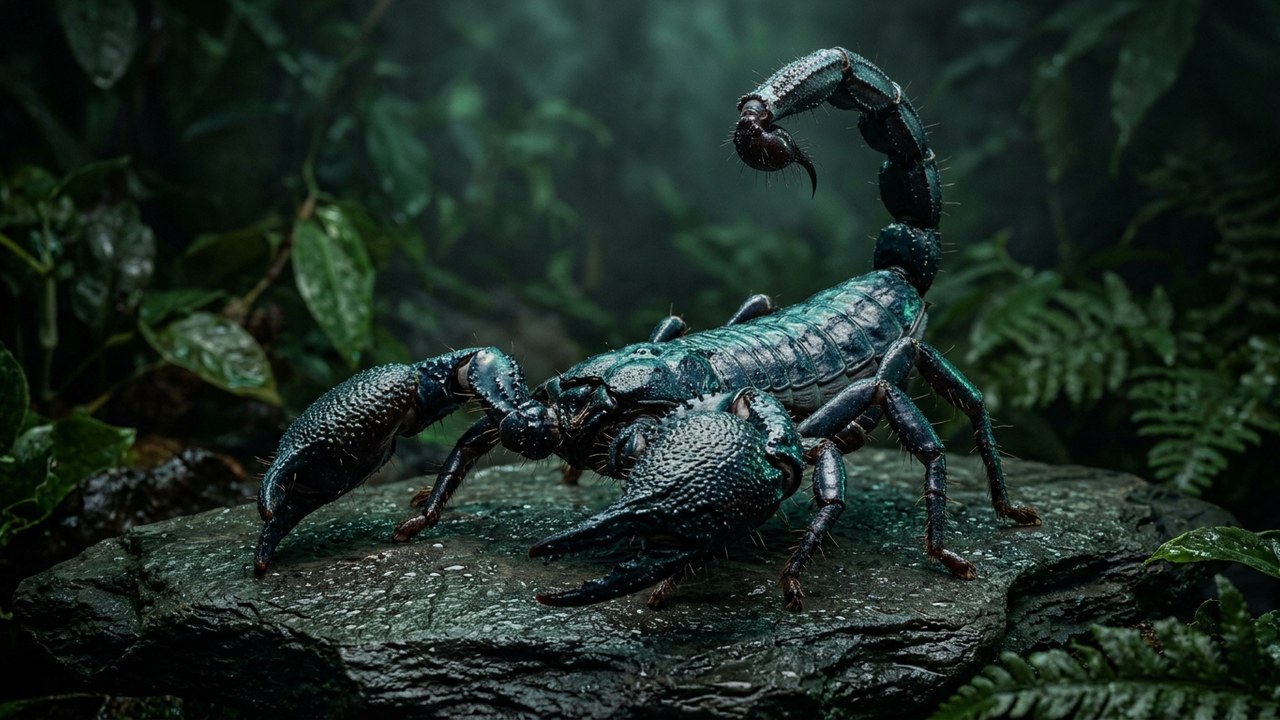
Among terrestrial arachnids, few species command as much scientific fascination as black scorpions—most notably the African Emperor Scorpion (Pandinus imperator) and Asian Forest Scorpions (Heterometrus species). With glossy obsidian carapaces, powerful pincers, and an evolutionary lineage stretching back more than 400 million years, these nocturnal invertebrates represent one of nature’s most enduring biological designs.
Anatomy of a Living Fossil
Despite their intimidating silhouette, large forest-dwelling black scorpions rely primarily on mechanical strength rather than high-potency venom. Arachnologists often point to a well-documented morphological principle: scorpions with heavy, broad pedipalps (chelae) typically possess milder venom, using brute crushing force to subdue insects, whereas species with slender pincers rely on potent neurotoxins.
- Chitinous Exoskeleton: A multi-layered armor plate that prevents desiccation in humid forests and shields delicate internal organs from predators.
- Segmented Metasoma (Tail): Ending in the venomous telson and stinger, raised defensively whenever the animal senses sudden thermal or air-current changes.
- Book Lungs: Four pairs of specialized respiratory plates located beneath the abdomen that allow efficient gas exchange in low-oxygen burrows.
Why Do Black Scorpions Glow Under Ultraviolet Light?
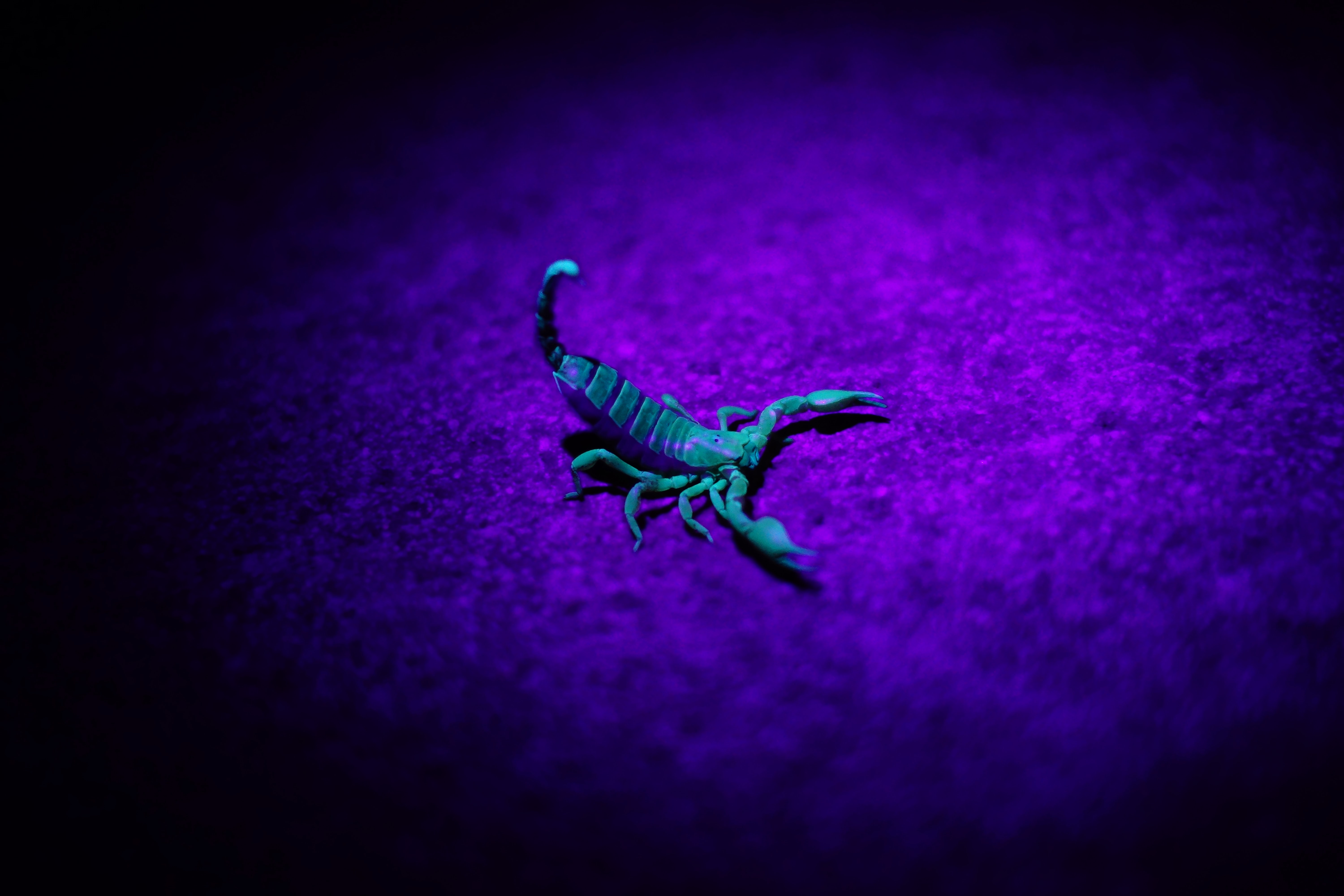
One of the most extraordinary discoveries in modern arachnology is that virtually all black scorpions fluoresce a vivid cyan-emerald hue when exposed to ultraviolet (UV-A) wavelengths. This bioluminescence-like glow originates in the hyaline layer—a thin, remarkably durable sheet within the outer cuticle containing fluorescent compounds such as beta-carboline and 4-methyl-7-hydroxycoumarin.
Field Research Insight
Biologists hypothesize that a scorpion’s entire exoskeleton acts as a whole-body light detector. By translating faint moonlight and starlight UV wavelengths into green-blue signals, the scorpion can gauge whether it is safely hidden beneath forest cover or exposed in open terrain.
Pectines and Vibration Sensing in Complete Darkness
Although black scorpions possess a pair of median eyes and several lateral eyes, their vision primarily distinguishes light from shadow. Instead of relying on sight, they navigate pitch-black forest floors using comb-like sensory appendages underneath their abdomen called pectines. Sweeping lightly across soil and bark, pectines detect microscopic chemical trails and ground vibrations from footsteps several centimeters away.
Ethical Sourcing and Tropical Habitat Standards
Because wild populations of Emperor Scorpions are protected under international CITES Appendix II regulations, responsible organizations prioritize documented captive-bred lineage and verified trade records. Maintaining healthy tropical black scorpions requires faithfully replicating humid rainforest microclimates:
- Thermal Range: A stable ambient gradient between 24°C and 28°C (75°F–82°F) without harsh overhead heat lamps.
- Humidity Control: 70% to 80% relative humidity supported by deep, moisture-retaining coconut fiber or organic soil substrates for natural burrowing.
- Low-Stress Enrichment: Cork bark hides, flat natural slate stones, and shallow water dishes that mirror forest-floor shelters.
Frequently Asked Questions
Are large black forest scorpions dangerously venomous to humans?
Most large rainforest species such as Pandinus imperator and Heterometrus carry mild venom comparable to a mild bee sting for non-allergic adults, relying instead on their strong pincers for prey capture.
How long do black scorpions live?
With proper thermal gradients, hydration, and low-stress environments, Emperor and Asian Forest scorpions routinely live 6 to 8 years—making them exceptionally long-lived arthropods.
Why do newly molted scorpions not glow under UV light?
Immediately after ecdysis (molting), the new cuticle is soft and has not yet hardened its hyaline layer. Fluorescence returns gradually over several days as the exoskeleton sclerotizes.