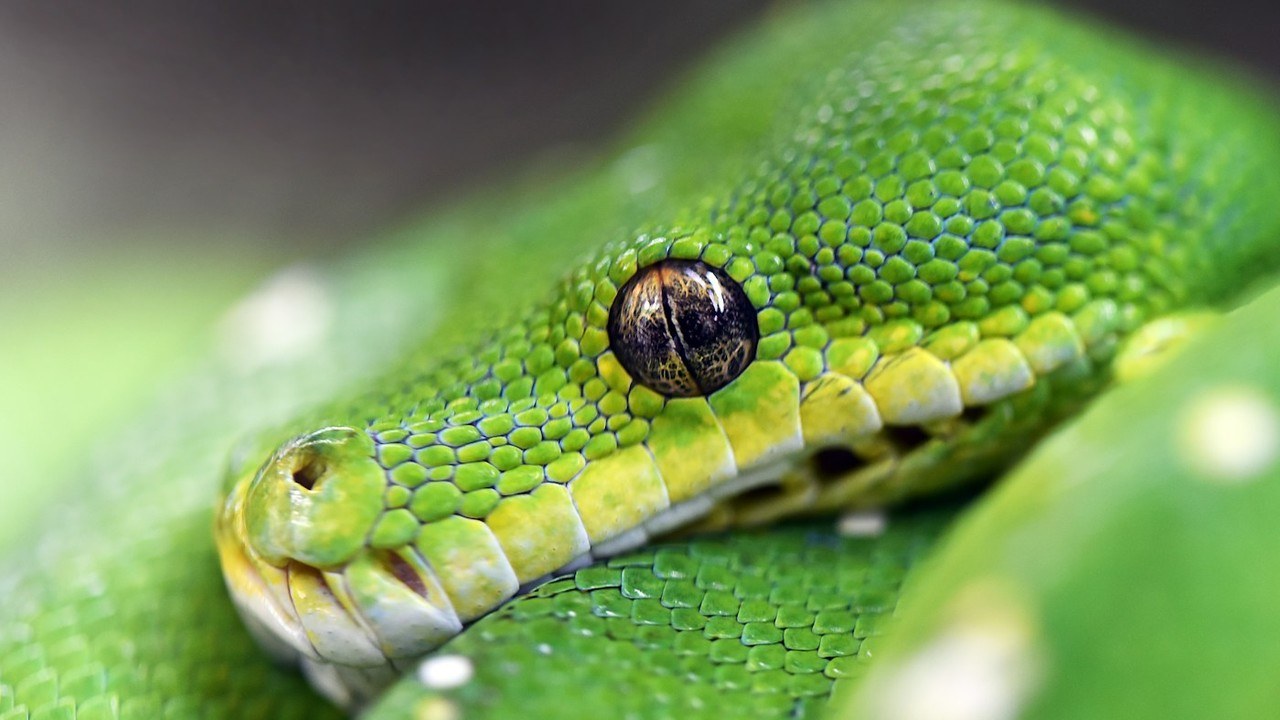
Across tropical canopies, arid deserts, and coastal wetlands, exotic snakes showcase some of the most specialized sensory and structural adaptations in vertebrate biology. Whether observing an emerald-and-obsidian arboreal python perched silently above a rainforest stream or studying terrestrial constrictors and vipers, herpetologists continually uncover engineering principles hidden within serpent anatomy.
Infrared Thermal Vision: How Pit Organs Detect Warmth
Many pythons, boas, and pit vipers perceive the world in both visible light and infrared thermal radiation. Specialized facial cavities—labial pits along the jaw in pythons and boas, and deep loreal pits between the eye and nostril in pit vipers—contain ultra-thin membranes packed with heat-sensitive TRPA1 ion channels.
- Precision Thermal Resolution: Pit membranes can register temperature variations as small as 0.003°C from up to a meter away in total darkness.
- Dual-Spectrum Overlay: Thermal signals route directly to the optic tectum of the snake’s brain, merging infrared heat silhouettes seamlessly with standard visual input.
Scale Architecture and Structural Iridescence
Contrary to common misconceptions, snake skin is dry, smooth, and remarkably clean. Each scale is an overlapping fold of epidermis fortified by tough beta-keratin on the exterior and flexible alpha-keratin at the hinges. Wide belly scales (gastrosteges) grip microscopic surface textures for silent rectilinear and serpentine movement, while microscopic nanoscale ridges on dark species diffract sunlight into dazzling emerald, violet, and sapphire iridescence.
The Jacobson’s Organ Advantage
Every time a snake flicks its forked tongue, the two tips sample airborne and surface odor molecules separately. Pressing those tips against the roof-mounted vomeronasal (Jacobson’s) organ gives the snake stereo chemical navigation—telling it instantly whether a scent trail turns left or right.
The Biology of Ecdysis (Shedding Cycles)
Because keratinized outer skin does not expand indefinitely as a snake grows, serpents periodically renew their entire outer epidermis in a process called ecdysis. Days before shedding, a milky lymphatic fluid accumulates between the old and new skin layers, turning the clear protective eye scales (spectacles) temporarily cloudy blue. Once the fluid reabsorbs and vision clears, the snake rubs its snout against rough bark or stone and slips cleanly out of the old skin in a single continuous piece.
Global Standards in Responsible Herpetology
Ethical reptile institutions uphold rigorous welfare benchmarks: dual thermal gradients allowing snakes to self-regulate metabolism, species-appropriate humidity for clean shedding, sturdy arboreal perches or secure terrestrial hides, strict quarantine biosecurity, and transparent CITES-compliant documentation.
Frequently Asked Questions
Why do exotic snakes turn cloudy-eyed before shedding?
Snakes lack eyelids; instead, a transparent scale called a spectacle protects each eye. During pre-shedding, separating lymph fluid turns this scale opaque blue before clearing right before the shed begins.
How often do healthy adult snakes shed their skin?
Fast-growing juvenile snakes may shed every 4 to 6 weeks, whereas mature adult snakes typically shed 3 to 6 times per year depending on species, season, and nutrition.
Do snakes hear sounds without external ears?
While snakes have no external ear openings, their jawbones connect directly to inner-ear structures, making them exquisitely sensitive to low-frequency ground and airborne vibrations.